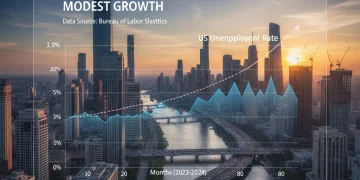
In an encouraging turn for the national economy, the latest employment trends report has unveiled a significant 0.5% dip in the unemployment rate this quarter. This positive shift, while seemingly modest, carries profound implications for the labor market, economic stability, and the financial well-being of millions across the country. Understanding the nuances behind this unemployment dip analysis is crucial for policymakers, businesses, and individuals alike as we navigate the evolving economic landscape. This article will delve deep into the data, explore the contributing factors, assess the sector-specific impacts, and project the potential long-term effects of this promising development.
The national unemployment rate, a key indicator of economic health, has been under intense scrutiny in recent years. Fluctuations can signal anything from robust economic expansion to impending recessionary pressures. Therefore, a consistent and measurable reduction, such as the 0.5% dip reported, is a strong signal that various economic engines are firing in unison. This comprehensive unemployment dip analysis will provide a holistic view, moving beyond the headline figure to uncover the stories and forces shaping our current employment reality.
Anúncios
Understanding the Latest Employment Trends Report
The recently released national employment trends report serves as a vital barometer for the health of the labor market. This quarter’s data indicates a tangible improvement, with the overall unemployment rate declining by half a percentage point. This reduction brings the national rate to its lowest point in over a year, a testament to sustained economic recovery and targeted policy interventions. The report meticulously details job creation across various sectors, changes in labor force participation, and shifts in demographic unemployment rates. A thorough unemployment dip analysis begins with dissecting these core components.
Key findings from the report highlight several positive indicators. Not only has the headline unemployment rate fallen, but the number of long-term unemployed individuals has also seen a noticeable decrease. This suggests that people who have been out of work for extended periods are successfully re-entering the workforce, a critical aspect of a healthy labor market. Furthermore, the labor force participation rate, which measures the proportion of the population that is either employed or actively looking for work, has remained stable or shown slight improvements in certain age groups, indicating a growing confidence in job prospects.
The report’s methodology is rigorous, drawing on extensive surveys of households and businesses. This dual approach provides a comprehensive picture, capturing both the supply and demand sides of the labor market. The household survey helps determine the unemployment rate, while the establishment survey provides insights into payroll employment and job creation by industry. This granular data allows for a precise unemployment dip analysis, enabling us to pinpoint where growth is occurring and where challenges might still persist.
Factors Contributing to the Unemployment Dip
Several intertwined factors have converged to bring about this welcome unemployment dip analysis. Economic policy, sector-specific growth, and evolving labor market dynamics all play crucial roles. One of the primary drivers has been a sustained period of economic growth, fueled by consumer spending and business investment. As consumer demand strengthens, businesses respond by expanding operations and hiring more staff to meet the increased production needs. Government stimulus measures, enacted in previous quarters, may also be showing lagged effects, continuing to inject liquidity into the economy and support job creation.
Technological advancements and innovation are also playing a significant role. Emerging industries, particularly in tech, green energy, and advanced manufacturing, are creating new job opportunities at a rapid pace. These sectors often require specialized skills, leading to increased demand for skilled labor and contributing to the overall reduction in unemployment. Furthermore, a renewed focus on reskilling and upskilling initiatives, both by governments and private entities, is helping bridge the skills gap, enabling more individuals to qualify for these new roles.
Anúncios
The global economic environment, while still facing headwinds in some regions, has also contributed positively. A stable international trade landscape and easing supply chain disruptions have allowed domestic businesses to operate more efficiently and confidently, leading to greater investment in human capital. This interconnectedness means that global stability often translates into domestic economic benefits, including a healthier job market. Our unemployment dip analysis would be incomplete without acknowledging these broader influences.
Finally, demographic shifts within the workforce are also a subtle but important factor. As certain cohorts retire, new entrants to the labor market, often with fresh skills and perspectives, are filling vacancies and contributing to overall productivity. The balance between those leaving the workforce and those entering it can significantly impact the unemployment rate, and the current dynamics appear to be favorable.
Sector-Specific Impacts and Job Creation Hotspots
While the national unemployment dip analysis provides an aggregate view, a closer look at individual sectors reveals where the most significant job creation is occurring. The latest report indicates that the services sector continues to be a dominant force in job growth. Within services, hospitality and leisure, healthcare, and professional and business services have shown particularly strong gains. The rebound in travel and entertainment post-pandemic has fueled hiring in hotels, restaurants, and recreational facilities. Healthcare, driven by an aging population and ongoing technological advancements in medical care, remains a consistently growing sector.

Manufacturing, particularly in advanced and high-tech areas, has also shown resilience and even growth in certain sub-sectors. Investments in automation and digitalization are transforming manufacturing, creating demand for skilled technicians and engineers. The construction industry, buoyed by infrastructure projects and a strong housing market, continues to add jobs, albeit with some regional variations. These sector-specific insights are crucial for understanding the underlying health of the economy and for guiding future workforce development policies. A detailed unemployment dip analysis helps identify these hotspots.
Conversely, some sectors may still be facing challenges or experiencing slower growth. Retail, for instance, continues to grapple with the shift towards e-commerce, leading to job restructuring rather than outright expansion. Understanding these disparities is essential for a balanced perspective on the overall employment picture. Policy interventions can then be tailored to support workers in struggling sectors through retraining programs or by incentivizing investment in new, growth-oriented industries within those regions.
Economic Implications of a Lower Unemployment Rate
A sustained unemployment dip analysis reveals a host of positive economic implications. Firstly, a lower unemployment rate generally translates into increased consumer confidence and spending. When more people are employed, they have greater disposable income, which fuels demand for goods and services. This, in turn, stimulates further production and job creation, creating a virtuous cycle of economic growth. Businesses also benefit from a larger customer base and potentially higher profits, which can lead to further investment and expansion.
Secondly, a tighter labor market often leads to wage growth. As the pool of available workers shrinks, employers may need to offer higher wages and better benefits to attract and retain talent. This can improve the living standards of workers, reduce income inequality, and provide a buffer against inflationary pressures. However, policymakers must carefully monitor wage growth to ensure it doesn’t spiral into excessive inflation, which could negate some of the benefits of a lower unemployment rate.
Thirdly, a robust job market can reduce the strain on social safety nets. With more people employed, fewer individuals rely on unemployment benefits and other forms of public assistance. This frees up government resources that can then be redirected to other critical areas, such as infrastructure development, education, or healthcare. The fiscal health of the nation improves as tax revenues increase from a larger employed population and higher earnings.
Finally, a lower unemployment rate can foster greater innovation and productivity. When businesses are competing for talent, they are incentivized to invest in technology and training to maximize the efficiency of their existing workforce. This can lead to advancements in processes and products, ultimately boosting the nation’s overall economic output and competitiveness on the global stage. The long-term benefits of a healthy labor market are far-reaching and underpin sustained national prosperity, as evidenced by a comprehensive unemployment dip analysis.
Challenges and Potential Headwinds
While the recent unemployment dip analysis is largely positive, it’s crucial to acknowledge potential challenges and headwinds that could impact future employment trends. One significant concern is inflation. While wage growth is generally desirable, if it outpaces productivity gains or is fueled by excessive demand, it could lead to higher prices across the board, eroding purchasing power. Central banks often respond to persistent inflation with interest rate hikes, which can slow economic growth and potentially cool the job market.
Another challenge lies in skill mismatches. Even with a lower overall unemployment rate, certain industries may still face labor shortages due to a lack of workers with the specific skills required for available jobs. This highlights the ongoing need for robust education and vocational training programs that align with the demands of the modern economy. Without addressing these mismatches, the benefits of a lower unemployment rate might not be evenly distributed across all demographics and regions.
Geopolitical instability and global economic slowdowns also pose risks. Events like international conflicts, trade disputes, or recessions in major trading partners can disrupt supply chains, reduce export demand, and dampen business confidence domestically. Such external shocks can quickly reverse positive employment trends, making a cautious and adaptive approach to economic policy essential. Our unemployment dip analysis must consider these external vulnerabilities.
Furthermore, the rapid pace of technological change, particularly in artificial intelligence and automation, presents both opportunities and potential disruptions. While these technologies create new jobs, they can also displace workers in traditional roles. Managing this transition will require proactive policies, including investment in lifelong learning and social safety nets, to ensure that the benefits of technological progress are broadly shared and that no segment of the workforce is left behind. A forward-looking unemployment dip analysis must account for these transformative forces.
The Future Outlook for the Labor Market
Looking ahead, the future outlook for the labor market, informed by this unemployment dip analysis, appears cautiously optimistic. The momentum generated by the recent decline in unemployment, coupled with ongoing economic growth, suggests that the labor market could continue to strengthen in the coming quarters. However, the pace of improvement may moderate as the economy approaches full employment, where virtually everyone who wants a job can find one.
Key trends to watch include the continued growth of the digital economy and green industries. These sectors are expected to be significant drivers of job creation, requiring a workforce equipped with skills in areas such as data science, cybersecurity, renewable energy technologies, and sustainable urban planning. Investment in education and training programs that focus on these future-oriented skills will be critical for maintaining a competitive workforce and sustaining low unemployment rates.

Policymakers will likely continue to monitor inflation closely, balancing the need to sustain job growth with the imperative to maintain price stability. This delicate balancing act will influence monetary policy decisions, which in turn will have a ripple effect on borrowing costs for businesses and consumers, thereby impacting hiring and investment. The flexibility and responsiveness of economic policy will be paramount in navigating potential economic fluctuations.
The role of remote and hybrid work models will also continue to evolve, reshaping how and where people work. This shift has implications for urban planning, transportation, and the demand for commercial real estate, but it also offers opportunities for businesses to tap into a broader talent pool and for workers to achieve greater work-life balance. Understanding these evolving work structures is part of a comprehensive unemployment dip analysis, as they influence labor force participation and productivity.
Ultimately, the long-term health of the labor market will depend on a combination of sound economic policies, private sector innovation, and a commitment to workforce development. By investing in human capital, fostering a dynamic business environment, and adapting to global economic changes, the nation can build on the positive momentum of the recent unemployment dip and achieve sustainable prosperity for all its citizens.
Conclusion: A Positive Step Forward for the Economy
The latest employment trends report, revealing a 0.5% dip in the national unemployment rate this quarter, marks a significant and encouraging milestone for the economy. This comprehensive unemployment dip analysis has highlighted that the reduction is not merely a statistical anomaly but a reflection of robust economic growth, strategic policy interventions, and dynamic sector-specific expansions. From the resurgence in the services sector to the steady growth in advanced manufacturing, various parts of the economy are contributing to this positive trajectory.
The implications of a lower unemployment rate are far-reaching, promising increased consumer spending, potential wage growth, reduced strain on social safety nets, and enhanced national productivity and innovation. These benefits collectively contribute to a more stable and prosperous economic environment for businesses and individuals alike. However, it is equally important to remain vigilant against potential headwinds such as inflationary pressures, skill mismatches, and global economic uncertainties, which could temper future progress.
Looking ahead, the labor market is poised for continued evolution, driven by technological advancements and shifting work paradigms. Sustaining this positive momentum will require ongoing investment in education and training, adaptive economic policies, and a proactive approach to addressing emerging challenges. The recent unemployment dip is more than just a number; it is a powerful indicator of resilience and recovery, providing a solid foundation upon which to build a more inclusive and robust future for the national workforce. This careful unemployment dip analysis underscores the importance of continued monitoring and strategic planning to ensure long-term economic health.