
Understanding and setting up your first 401(k) can feel like navigating a complex financial labyrinth. However, with the right guidance, it’s a straightforward process that lays the foundation for a secure and comfortable retirement. As we look towards 2026, the principles of smart retirement planning remain consistent, but staying informed about current regulations and best practices is crucial. This comprehensive guide is designed specifically for beginners, offering a step-by-step approach to configuring your first 401(k) and demystifying the journey to financial independence.
Anúncios
Many people delay starting their retirement savings, often due to a lack of understanding or feeling overwhelmed by the choices. This procrastination can be costly. The earlier you begin contributing to your 401(k), the more you benefit from the power of compounding interest, where your earnings generate their own earnings. This guide aims to empower you with the knowledge and confidence to take that crucial first step in setting up your first 401(k) in 2026, ensuring you make informed decisions that align with your long-term financial goals.
What is a 401(k) and Why is it Important?
Before diving into the setup process, let’s clarify what a 401(k) is. A 401(k) is an employer-sponsored retirement savings plan that allows employees to invest a portion of their paycheck before taxes are withheld. This pre-tax contribution reduces your taxable income for the year, potentially lowering your current tax bill. The money in your 401(k) grows tax-deferred, meaning you don’t pay taxes on investment gains until you withdraw the money in retirement.
The importance of a 401(k) cannot be overstated. For many, it’s the cornerstone of their retirement strategy. Here’s why:
- Tax Advantages: As mentioned, contributions are often pre-tax (traditional 401(k)), lowering your current taxable income. Some plans also offer a Roth 401(k) option, where contributions are after-tax, but qualified withdrawals in retirement are tax-free.
- Employer Match: This is arguably the most compelling reason to contribute. Many employers offer to match a portion of your contributions, essentially providing free money. Failing to contribute enough to get the full employer match is like leaving money on the table.
- Compounding Growth: Your investments grow over decades, and the earnings themselves earn returns. This exponential growth can turn modest contributions into a substantial nest egg.
- Convenience: Contributions are typically deducted directly from your paycheck, making saving automatic and consistent.
- Higher Contribution Limits: 401(k)s generally allow for higher annual contributions compared to other retirement accounts like IRAs, enabling you to save more aggressively.
Understanding these fundamental benefits is the first step in appreciating the value of setting up your first 401(k) as early as possible.
Anúncios
Step-by-Step Guide to Setting Up Your First 401(k) in 2026
Step 1: Confirm Eligibility and Enrollment
Your journey to setting up your first 401(k) begins with your employer. Most employers offer 401(k) plans to eligible employees, but eligibility requirements can vary. Typically, you might need to be a full-time employee, have worked for a certain period (e.g., 90 days or one year), or be over a specific age. Contact your HR department or benefits administrator to understand your company’s specific eligibility rules and enrollment periods. Many plans have open enrollment periods, but some allow enrollment at any time after meeting eligibility criteria.
Upon confirming your eligibility, your employer will provide you with enrollment materials. These may be physical documents or, more commonly now, access to an online portal where you can manage your benefits. Don’t hesitate to ask your HR team for assistance if you find the process confusing.
Step 2: Decide on Your Contribution Amount
This is a critical decision when setting up your first 401(k). The general advice is to contribute as much as you can comfortably afford, especially enough to receive the full employer match. For example, if your employer matches 50% of your contributions up to 6% of your salary, you should aim to contribute at least 6% to maximize this “free money.”
For 2026, the IRS contribution limits for 401(k)s are expected to be announced later in 2025, but they typically increase slightly each year to account for inflation. As a reference, in 2024, the limit for employee contributions was $23,000, with an additional catch-up contribution of $7,500 for those aged 50 and over. While aiming for the maximum is ideal, start with what’s feasible and plan to increase your contributions annually, perhaps by 1% or 2% each time you get a raise. Even small increases can make a significant difference over time.
Step 3: Choose Between Traditional and Roth 401(k) (If Available)
When setting up your first 401(k), you might have the option between a Traditional 401(k) and a Roth 401(k). Understanding the difference is key to making the right choice for your tax situation:
- Traditional 401(k): Contributions are made with pre-tax dollars, meaning they reduce your current taxable income. Your investments grow tax-deferred, and you pay taxes on withdrawals in retirement. This option is generally beneficial if you expect to be in a lower tax bracket in retirement than you are now.
- Roth 401(k): Contributions are made with after-tax dollars, meaning they do not reduce your current taxable income. However, qualified withdrawals in retirement are completely tax-free. This option is often favored if you expect to be in a higher tax bracket in retirement or if you want to diversify your tax exposure in retirement.
Some employers offer both options, allowing you to split your contributions between them. Consider your current income, your projected income in retirement, and your overall tax strategy when making this decision. If unsure, consulting with a financial advisor can provide personalized insights.
Step 4: Select Your Investment Options
This is where many beginners feel overwhelmed, but it doesn’t have to be complicated. Your 401(k) plan typically offers a curated list of investment options, primarily mutual funds and exchange-traded funds (ETFs), covering various asset classes like stocks, bonds, and money market accounts.
Here’s how to approach selecting investments when setting up your first 401(k):
- Target-Date Funds (TDFs): For beginners, TDFs are an excellent starting point. You simply choose a fund with a target date closest to your estimated retirement year (e.g., a 2060 fund if you plan to retire around that time). These funds automatically adjust their asset allocation over time, becoming more conservative as you approach retirement. They offer diversification and professional management with minimal effort.
- Index Funds/ETFs: These funds aim to mirror the performance of a specific market index, like the S&P 500. They typically have lower fees than actively managed funds and offer broad market exposure. A mix of large-cap, mid-cap, and international index funds can provide good diversification.
- Diversification: Avoid putting all your eggs in one basket. A well-diversified portfolio spreads your investments across different asset classes, industries, and geographies to mitigate risk.
- Expense Ratios: Pay attention to expense ratios, which are the annual fees charged by funds. Lower expense ratios mean more of your money stays invested and grows.
Your plan administrator will provide detailed information on each investment option, including performance history, fees, and risk levels. Take the time to review these or seek advice if needed. Remember, your investment choices can be adjusted over time as your financial situation and risk tolerance change.

Step 5: Designate Your Beneficiaries
An often-overlooked but crucial step when setting up your first 401(k) is designating beneficiaries. These are the individuals who will inherit your 401(k) assets if you pass away. Without proper beneficiary designations, your account could go through probate, a legal process that can be lengthy and costly, and the assets may not be distributed according to your wishes. You can usually designate primary and secondary beneficiaries.
It’s important to keep your beneficiary designations up to date, especially after major life events such as marriage, divorce, or the birth of a child. Regularly review this information, perhaps annually, to ensure it reflects your current wishes.
Step 6: Monitor and Adjust Your 401(k) Regularly
Setting up your first 401(k) isn’t a one-and-done task. It requires periodic monitoring and adjustments to ensure it remains aligned with your financial goals and life circumstances. Here’s what to look for:
- Rebalance Your Portfolio: Over time, some investments may grow faster than others, throwing your desired asset allocation out of whack. Rebalancing involves selling some of the overperforming assets and buying more of the underperforming ones to bring your portfolio back to its target allocation. Target-date funds do this automatically, but if you’ve chosen individual funds, you’ll need to do it manually, typically once a year.
- Review Contribution Amounts: As your salary increases or your financial situation changes, consider increasing your contributions. Aim to max out your contributions if possible, especially as you get closer to retirement.
- Check Investment Performance and Fees: While you shouldn’t obsess over daily market fluctuations, it’s wise to periodically review the performance of your chosen funds and compare their fees to similar options. If a fund consistently underperforms its benchmark or has excessively high fees, consider making a change.
- Life Events: Major life changes (marriage, divorce, new children, buying a home) can impact your financial goals and risk tolerance. Revisit your 401(k) strategy and beneficiary designations after such events.
Regular monitoring ensures your 401(k) continues to work hard for your retirement.
Understanding Vesting Schedules
When you’re setting up your first 401(k), it’s crucial to understand “vesting.” While your contributions are always 100% yours, employer matching contributions may be subject to a vesting schedule. Vesting refers to the amount of time you must work for your employer to gain full ownership of their contributions.
There are typically two main types of vesting schedules:
- Cliff Vesting: You become 100% vested after a specific period (e.g., three years). If you leave before that period, you forfeit all employer contributions.
- Graded Vesting: You become gradually vested over several years. For example, you might be 20% vested after two years, 40% after three, and so on, until you reach 100%.
Always check your plan documents or with HR to understand your company’s vesting schedule. This knowledge can influence your career decisions, especially if you’re considering changing jobs.
Common 401(k) Mistakes to Avoid
Even with a clear guide, it’s easy to fall into common traps when setting up your first 401(k) and managing it. Being aware of these can help you steer clear:
- Not Contributing Enough to Get the Full Employer Match: This is the biggest mistake. The employer match is free money, and not taking advantage of it means you’re leaving a significant return on the table.
- Cashing Out Your 401(k) When Changing Jobs: While tempting, cashing out your 401(k) before retirement incurs income taxes and a 10% early withdrawal penalty (if you’re under 59½). Instead, roll it over into your new employer’s plan or an IRA.
- Taking a 401(k) Loan: While some plans allow loans, it’s generally advisable to avoid them. If you leave your job, you typically have to repay the loan quickly, or it becomes a taxable distribution.
- Being Too Conservative (or Too Aggressive) with Investments: A common mistake for young investors is being too conservative, missing out on growth. Conversely, being overly aggressive as you near retirement can expose you to unnecessary risk. Find a balance that aligns with your age and risk tolerance.
- Ignoring Your 401(k) After Setup: As mentioned, your 401(k) needs periodic attention. Don’t set it and forget it entirely; review and adjust as needed.
- Not Understanding Fees: High fees can significantly erode your returns over time. Always be aware of the expense ratios of your chosen funds.
Avoiding these pitfalls will help ensure your first 401(k) setup is as effective as possible.
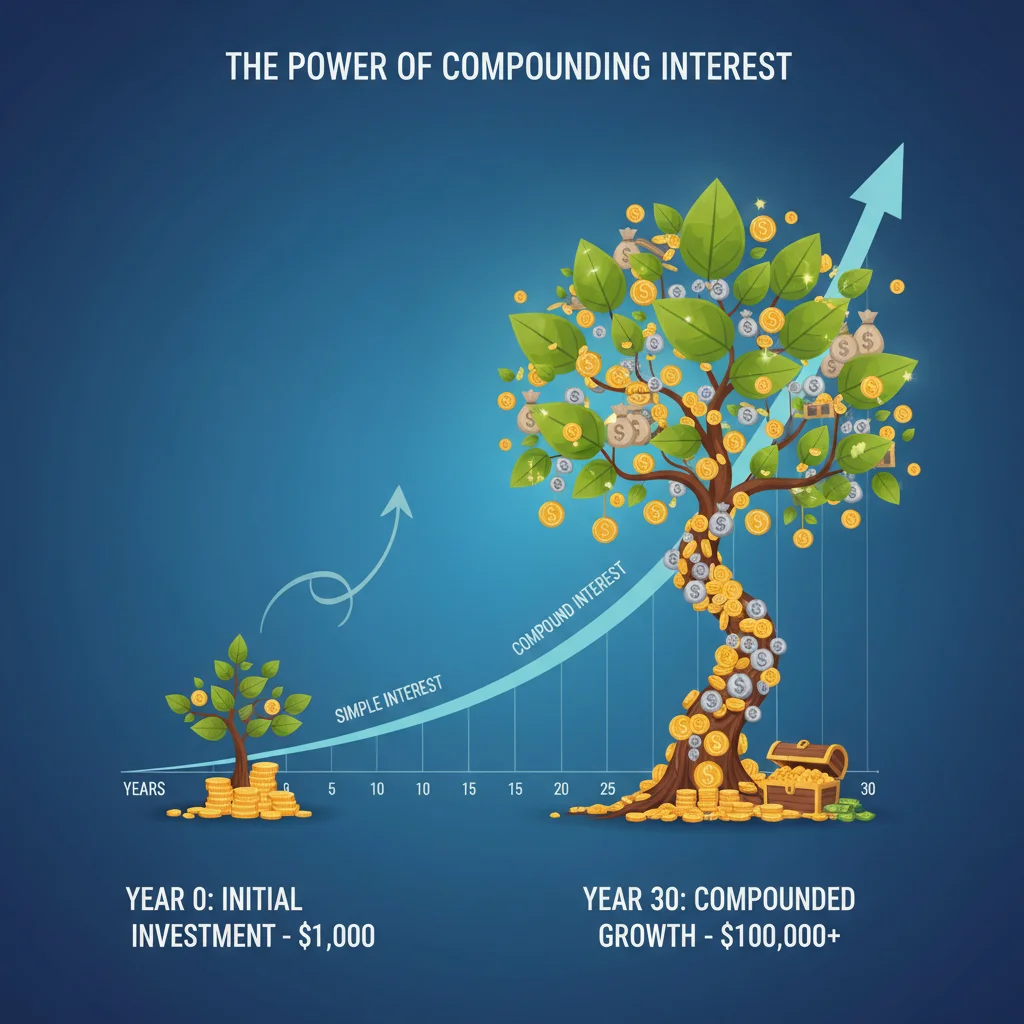
The Power of Compounding and Time
One of the most profound concepts in retirement planning, particularly when setting up your first 401(k), is the power of compounding interest. Albert Einstein reportedly called compounding the “eighth wonder of the world.” Here’s why:
Compounding means that your investment earnings themselves start earning returns. The longer your money is invested, the more significant this effect becomes. Even modest contributions made early in your career can grow into a substantial sum by retirement, far outweighing larger contributions made later on. This is why starting to set up your first 401(k) as early as possible is so critical. Time is your greatest asset in retirement planning.
Consider two individuals: Alice starts investing $200 per month at age 25 and stops at age 35 (10 years of contributions). Bob starts investing $200 per month at age 35 and continues until age 65 (30 years of contributions). Assuming an average annual return of 7%, Alice, who contributed for fewer years but started earlier, will likely have significantly more money at age 65 than Bob. This illustrates the immense advantage of starting early and letting compounding work its magic.
Integrating Your 401(k) with Overall Financial Planning
While setting up your first 401(k) is a monumental step, it’s just one piece of your broader financial puzzle. For optimal financial health, integrate your 401(k) strategy with other aspects of your financial planning:
- Emergency Fund: Before aggressively saving for retirement, ensure you have a solid emergency fund (3-6 months of living expenses) saved in an easily accessible, liquid account. This prevents you from needing to tap into your 401(k) for unexpected expenses.
- Debt Management: High-interest debt (like credit card debt) can quickly erode your financial progress. Prioritize paying down such debt while also contributing enough to your 401(k) to get the employer match.
- Other Investment Vehicles: Once you’ve maximized your 401(k) contributions (especially if you hit the annual limit), consider other tax-advantaged accounts like IRAs (Traditional or Roth) or HSAs (Health Savings Accounts) if eligible.
- Financial Goals: Align your 401(k) contributions and investment strategy with your broader financial goals, whether it’s buying a home, funding education, or early retirement.
- Estate Planning: Your 401(k) is a significant asset. Ensure it’s integrated into your overall estate plan, alongside your will and other legal documents.
A holistic approach ensures all your financial components work in harmony towards your ultimate financial well-being.
What to Expect in 2026 and Beyond
While the core principles of setting up your first 401(k) remain constant, the financial landscape is always evolving. Here are a few considerations for 2026 and the future:
- Contribution Limit Adjustments: Expect annual adjustments to 401(k) contribution limits due to inflation. Always check the IRS guidelines for the most up-to-date figures.
- Regulatory Changes: Retirement savings plans are subject to governmental regulations. Stay informed about any legislative changes that might impact 401(k)s, such as changes to RMDs (Required Minimum Distributions) or Roth conversion rules.
- Investment Landscape: The investment world is dynamic. New investment products, technologies, and market trends emerge. While target-date funds simplify this, if you’re actively managing your portfolio, stay educated on market developments.
- Personalized Financial Advice: As your financial situation becomes more complex, consider engaging with a certified financial planner. They can offer tailored advice, help you navigate complex decisions, and ensure your 401(k) strategy aligns perfectly with your life goals.
Proactive engagement with your 401(k) and staying informed will serve you well for decades to come.
Conclusion: Your Path to Retirement Security Starts Now
Setting up your first 401(k) in 2026 is one of the most impactful financial decisions you can make for your future. It’s a powerful tool for building wealth, leveraging tax advantages, and benefiting from potential employer contributions. By following this step-by-step guide – from confirming eligibility and deciding on contributions to selecting investments and monitoring your account – you can confidently navigate the process and establish a strong foundation for your retirement savings.
Don’t let the perceived complexity deter you. The sooner you start, the more time your money has to grow, thanks to the magic of compounding. Take advantage of employer matches, make informed investment choices, and regularly review your plan. Your future self will thank you for taking these proactive steps today. Embrace the journey to financial security, and enjoy the peace of mind that comes with a well-planned retirement.