How to Apply for Federal Student Aid in 2026: A Detailed Walkthrough for New Applicants
Navigating the world of college finances can feel like deciphering a complex code, especially for new applicants. However, understanding and applying for federal student aid is a critical step that can significantly reduce the financial burden of higher education. For the 2026-2027 academic year, preparing early and understanding the process is more important than ever. This comprehensive guide will walk you through every aspect of applying for federal student aid, ensuring you’re well-equipped to secure the funding you need.
Anúncios
Understanding Federal Student Aid: What It Is and Why It Matters
Federal student aid encompasses various forms of financial assistance provided by the U.S. government to help students pay for college or career school. This aid can come in the form of grants, scholarships, work-study programs, and low-interest loans. Unlike private loans, federal aid often offers more flexible repayment options, lower interest rates, and potential for loan forgiveness, making it an invaluable resource for countless students.
The primary application for federal student aid is the Free Application for Federal Student Aid (FAFSA). Completing the FAFSA is the gateway to unlocking not only federal funding but also many state and institutional aid programs. Without a completed FAFSA, you could be missing out on thousands of dollars in assistance that could make your educational dreams a reality.
For the 2026-2027 award year, the FAFSA will typically open on October 1, 2025. While this might seem far off, understanding the requirements and gathering necessary documents well in advance can streamline the application process significantly. This guide will focus on the FAFSA for the 2026-2027 academic year, offering insights and tips tailored for new applicants.
Key Changes and Considerations for the 2026-2027 FAFSA
While the core purpose of the FAFSA remains the same, the application process has undergone significant modernization in recent years, starting with the 2024-2025 FAFSA. These changes aim to simplify the form and make it more accessible. For the 2026-2027 FAFSA, applicants can expect a more streamlined experience, but it’s crucial to be aware of the ongoing evolution. Key changes include:
- Simplified Form: The FAFSA has been significantly shortened, reducing the number of questions. This makes the application process quicker and less daunting.
- Direct Data Exchange with IRS: The IRS Direct Data Exchange (DDX) is now mandatory for most applicants and contributors (parents/spouses). This allows for direct transfer of tax information, reducing errors and simplifying data entry. All contributors must provide consent for the IRS to share their tax information, even if they didn’t file taxes. Without consent, the student will not be eligible for federal student aid.
- New Terminology: Terms like ‘Expected Family Contribution’ (EFC) have been replaced with the ‘Student Aid Index’ (SAI). The SAI is an eligibility index number that financial aid administrators use to determine how much federal student aid a student could receive. It’s not the amount of money your family will have to pay.
- Expanded Eligibility: The new FAFSA calculation methodology aims to expand Pell Grant eligibility to more students and provide a more accurate assessment of a family’s ability to pay.
- Contributor Role: Anyone required to provide information on the FAFSA (student, parent, spouse) is now referred to as a ‘contributor.’ Each contributor needs their own FSA ID.
Staying informed about these changes is vital for a smooth application. The Department of Education continuously updates its guidance, so regularly checking their official website is recommended.
Anúncios
Step 1: Get Ready – Essential Preparations for Your FAFSA Application
Before you even think about filling out the form, proper preparation is key. This initial phase can save you a lot of time and stress down the line. Here’s what you need to do:
Create Your FSA ID
The FSA ID is your digital signature and the key to accessing federal student aid online systems. Both the student and at least one parent (if the student is dependent) will need an FSA ID. It’s a username and password combination that identifies you electronically. You can create your FSA ID at studentaid.gov. It’s best to do this well in advance, as it can take a few days for the FSA ID to become active after verification.
- Student: Needs an FSA ID.
- Parent(s) of Dependent Student: At least one parent needs an FSA ID.
- Spouse (if applicable): If you are married and filing jointly or your spouse’s income is required, they may need an FSA ID.
Remember to keep your FSA ID and password in a secure place. You’ll use it every year you apply for federal student aid.
Gather Required Documents and Information
Even with the simplified FAFSA, you’ll need certain documents to complete the application accurately. Having these ready will make the process much faster. For the 2026-2027 FAFSA, you’ll be reporting income information from the 2024 tax year. Here’s a checklist:
- Social Security Numbers: For the student, parents (if dependent), and spouse (if applicable). Make sure these are accurate.
- Alien Registration Number (if not a U.S. citizen): For eligible non-citizens.
- Federal Tax Information:
- 2024 federal income tax returns (IRS Form 1040, 1040-SR, 1040-NR).
- W-2 Forms and other records of money earned in 2024.
- Records of untaxed income for 2024 (e.g., child support received, interest income, veterans non-education benefits).
- Records of Assets: As of the day you complete the FAFSA.
- Cash, savings, and checking account balances.
- Net worth of investments (real estate, stocks, bonds, mutual funds, other securities, trusts, etc.).
- Net worth of businesses and farms (only if they meet specific criteria, often not required for small family businesses).
- List of Colleges You’re Considering: You can list up to 20 schools on the online FAFSA.
The IRS Direct Data Exchange (DDX) will automatically transfer most of your tax information, but it’s good to have your tax returns on hand for reference, especially if you need to manually enter any data or verify information.

Step 2: Completing the FAFSA – A Section-by-Section Guide
Once you have your FSA ID and all your documents, you’re ready to tackle the FAFSA. Go to studentaid.gov/fafsa to begin. The application is broken down into several sections:
1. Student Demographics
This section asks for basic information about the student, including name, date of birth, Social Security Number, contact information, and citizenship status. It also asks about your high school completion status and enrollment plans.
2. School Selection
Here, you’ll list the colleges you are interested in. It’s crucial to list all schools you’re considering, even if you haven’t been accepted yet. Each school you list will receive your FAFSA information and can then determine your eligibility for institutional aid. You can add or remove schools later if needed.
3. Dependency Status
The FAFSA determines whether you are a dependent or independent student. This is a critical distinction because it dictates whether you need to provide parental information. Most undergraduate students are considered dependent. You are generally considered independent if you are:
- 24 years old by December 31st of the award year.
- Married.
- A graduate or professional student.
- Serving in the U.S. Armed Forces or a veteran.
- An orphan, ward of the court, or in foster care.
- Emancipated minor or in a legal guardianship.
- Homeless or at risk of being homeless.
- Have children or other dependents for whom you provide more than half of their support.
If you answer ‘yes’ to any of the dependency questions, you will be considered independent and will not need to provide parent information (unless you are married, then you provide spouse’s information). If you answer ‘no’ to all dependency questions, you are considered dependent, and you will proceed to the parent information section.
4. Parent Demographics (for Dependent Students)
If you are a dependent student, this section will ask for information about your parents, including their marital status, Social Security Numbers, and contact information. The FAFSA uses specific rules to determine which parent’s information to report, especially in cases of divorce or separation. Generally, it’s the parent you lived with more during the past 12 months. If that parent is remarried, you will also include the stepparent’s information.
5. Financial Information (Student and Parent/Spouse)
This is where the IRS Direct Data Exchange (DDX) comes into play. You (and your parents/spouse, if applicable) will be prompted to provide consent to retrieve your 2024 tax information directly from the IRS. This is a mandatory step for eligibility. Even if you did not file taxes, you must still provide consent. The FAFSA will then ask about untaxed income and asset information (cash, savings, investments, etc.) for both the student and the contributors.
Be meticulous when entering asset information. Only report the net worth (value minus debt) of investments, not the total value. For example, if you own a rental property worth $200,000 with a mortgage of $150,000, your net worth for that asset is $50,000.
6. Sign and Submit
Once all sections are complete, you will review your application for accuracy. Both the student and all contributors must electronically sign the FAFSA using their FSA IDs. After all required signatures are provided, you can submit your application. You will receive a confirmation email with a confirmation number. Keep this for your records.
Step 3: What Happens After You Submit Your FAFSA?
Submitting your FAFSA is a significant milestone, but the process doesn’t end there. Here’s what to expect next:
Confirmation and FAFSA Submission Summary (FSS)
Shortly after submission, you’ll receive a FAFSA Submission Summary (FSS), which replaces the old Student Aid Report (SAR). This document summarizes the information you provided on your FAFSA, including your Student Aid Index (SAI). Review this document carefully for any errors. If you find mistakes, you can log back into your FAFSA and make corrections.
Financial Aid Offers from Colleges
Once colleges receive your FAFSA information, their financial aid offices will begin packaging financial aid offers. These offers typically detail the types and amounts of federal student aid (grants, work-study, loans) and institutional aid (scholarships, grants from the school) you are eligible for. Financial aid offers usually start rolling out in the spring, often after admission decisions are made.
Compare financial aid offers from different schools carefully. Look beyond just the sticker price and consider the net price (cost of attendance minus grants and scholarships). Understand the difference between ‘gift aid’ (grants, scholarships that don’t need to be repaid) and ‘self-help aid’ (loans, work-study that do need to be repaid or earned).
Verification Process
Some students are selected for a process called ‘verification.’ This means the financial aid office at your chosen college will request additional documents (e.g., tax transcripts, household size verification) to confirm the information you reported on your FAFSA. If selected, respond promptly to all requests from your college’s financial aid office to avoid delays in receiving your aid.
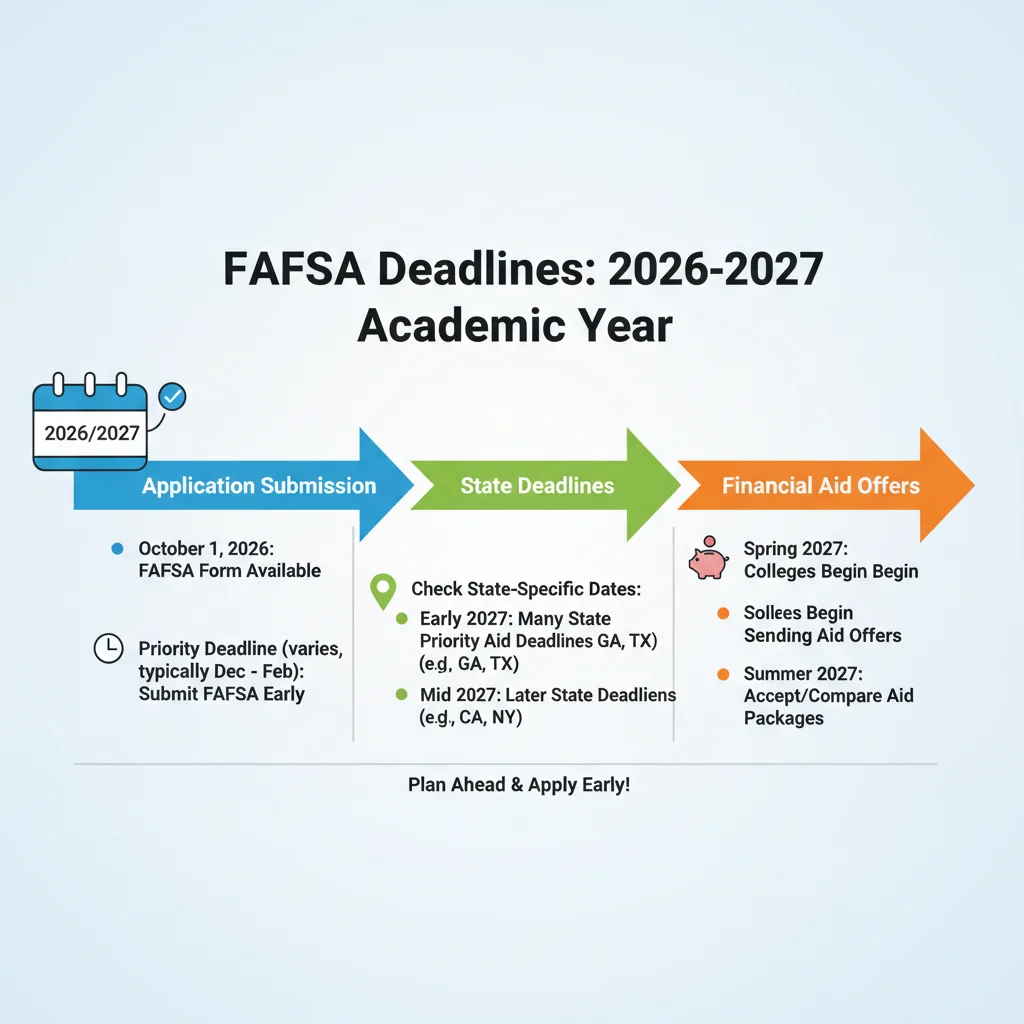
Important Deadlines for Federal Student Aid 2026-2027
Missing deadlines can mean missing out on aid. There are three main types of deadlines to be aware of:
- Federal Deadline: The federal deadline for the 2026-2027 FAFSA is June 30, 2027. However, this is very late in the cycle and you should never aim for this date.
- State Deadlines: Many states have their own deadlines for state aid programs, which can be much earlier. Some are as early as February or March 2026. Check your state’s specific deadline on the FAFSA website.
- College Deadlines: Each college you apply to may have its own deadline for submitting the FAFSA to be considered for institutional aid. These can vary widely, but often align with admission application deadlines.
Pro Tip: Aim to complete your FAFSA as soon as it opens (October 1, 2025) or as close to it as possible. Many aid programs, especially state and institutional grants, are awarded on a first-come, first-served basis until funds run out.
Types of Federal Student Aid Available
Understanding the different types of federal student aid will help you make informed decisions about your financial package:
1. Grants
Grants are often called ‘gift aid’ because they do not have to be repaid. They are usually need-based, meaning eligibility is determined by your financial situation. The most common federal grants include:
- Pell Grants: Awarded to undergraduate students with exceptional financial need. The maximum Pell Grant amount changes annually.
- Federal Supplemental Educational Opportunity Grants (FSEOG): For undergraduate students with exceptional financial need. These are administered directly by the financial aid office at participating schools.
- Teacher Education Assistance for College and Higher Education (TEACH) Grants: For students who agree to teach in high-need fields in low-income schools for at least four years after graduation.
- Iraq and Afghanistan Service Grants: For students whose parent or guardian died as a result of military service in Iraq or Afghanistan after 9/11.
2. Work-Study
Federal Work-Study (FWS) provides part-time jobs for undergraduate and graduate students with financial need, allowing them to earn money to help pay for educational expenses. The jobs are often related to your course of study or community service. Earnings are paid directly to the student and do not count against future federal student aid eligibility in the same way other income might.
3. Loans
Federal student loans are funds you borrow and must repay with interest. They generally offer more favorable terms than private loans. The main types are:
- Direct Subsidized Loans: For undergraduate students with demonstrated financial need. The U.S. Department of Education pays the interest while you’re in school at least half-time, during your grace period, and during deferment.
- Direct Unsubsidized Loans: Available to undergraduate and graduate students regardless of financial need. You are responsible for paying the interest during all periods. If you choose not to pay the interest while you’re in school, it will accrue and be added to your principal balance.
- Direct PLUS Loans: These are available to graduate or professional students (Grad PLUS) and parents of dependent undergraduate students (Parent PLUS). Eligibility is not based on financial need, but a credit check is required.
- Direct Consolidation Loans: Allow you to combine multiple federal education loans into one loan with a single loan servicer.
Common FAFSA Mistakes to Avoid
Even with a simplified form, mistakes can happen. Avoiding these common errors can save you time and ensure you receive all the aid you’re eligible for:
- Not Completing the FAFSA: This is the biggest mistake! Many students think they won’t qualify for aid, but you never know until you apply. Even high-income families can qualify for unsubsidized loans or certain scholarships.
- Missing Deadlines: As emphasized, deadlines are crucial. Mark them on your calendar.
- Incorrect Social Security Numbers: A single digit error can cause significant delays. Double-check all SSNs.
- Incorrectly Reporting Dependency Status: Be honest and accurate. If you’re unsure, consult the FAFSA guidelines or your high school counselor.
- Forgetting to Sign Electronically: The FAFSA isn’t submitted until all required parties sign it with their FSA IDs.
- Not Using the IRS Direct Data Exchange (DDX): This tool is designed to prevent errors and simplify the process. Use it!
- Reporting Current Year Tax Information: Remember, for the 2026-2027 FAFSA, you’ll use 2024 tax information.
- Not Listing All Schools: List every school you’re considering to ensure they receive your aid information.
- Ignoring the FAFSA Submission Summary (FSS): Always review it for accuracy.
Special Circumstances and Appealing Financial Aid Decisions
Life happens, and sometimes your current financial situation is significantly different from the tax year reported on your FAFSA (2024 income for the 2026-2027 FAFSA). If you or your family have experienced a significant change in income or other unusual circumstances (e.g., job loss, divorce, death of a parent, high medical expenses not covered by insurance), you can appeal your financial aid decision.
This process is known as ‘professional judgment.’ Contact the financial aid office at each college you are interested in. Explain your situation and provide documentation. They have the discretion to adjust your FAFSA data and potentially offer more aid. Don’t be afraid to ask; financial aid officers are there to help.
Beyond Federal Student Aid: Other Funding Sources
While federal student aid is foundational, it’s not the only source of funding. Consider these additional avenues:
- State Aid: Many states offer their own grant and scholarship programs. Often, completing the FAFSA is the first step to applying for these.
- Institutional Aid: Colleges and universities offer their own scholarships and grants, often based on merit, need, or specific talents. Check with each school’s financial aid office.
- Private Scholarships: Numerous organizations, foundations, and businesses offer scholarships. Websites like Fastweb, Scholarship.com, and the College Board’s Scholarship Search can help you find these.
- Private Loans: These are offered by banks, credit unions, and other private lenders. They generally have higher interest rates and fewer borrower protections than federal loans. Exhaust all federal aid options before considering private loans.
Conclusion: Your Path to Affordable Education Starts Here
Applying for federal student aid is an essential step toward making higher education affordable. While the process requires attention to detail and adherence to deadlines, the rewards—in the form of grants, work-study, and low-interest loans—are invaluable. By understanding the FAFSA process for the 2026-2027 academic year, gathering your documents early, accurately completing the application, and following up on aid offers, you can significantly reduce the financial stress associated with college.
Remember, the Department of Education’s studentaid.gov website is your authoritative source for all FAFSA-related information. Don’t hesitate to use their resources, and always reach out to the financial aid offices of your prospective schools if you have questions. Your future education is an investment, and federal student aid is designed to help you make that investment a reality.